AWS for SRE: Reliability Engineering Basics ⚙️☁️
Tech enthusiast | Code craftsman | DevOps explorer | Turning bugs into features one line at a time 🚀
Many DevOps engineers eventually move toward SRE (Site Reliability Engineering) roles.
SRE focuses on one main goal:
Keep systems reliable, fast, and available at scale.
AWS provides powerful building blocks to implement SRE principles in real systems.
In this blog, you’ll learn SRE fundamentals, how they map to AWS services, and how DevOps engineers can think like SREs.
What Is SRE?
SRE is a discipline that applies software engineering principles to operations.
Instead of manually fixing servers:
👉 You automate reliability
SRE focuses on:
Availability
Latency
Performance
Capacity
Reliability
DevOps vs SRE (Quick View)
| DevOps | SRE |
| Speed & automation | Reliability & stability |
| CI/CD pipelines | SLOs & error budgets |
| Tool-focused | Metrics-focused |
| Delivery | Uptime |
They are complementary, not competing.
Core SRE Concepts
1️⃣ SLI (Service Level Indicator)
Metric that measures behavior.
Examples:
Request latency
Error rate
Availability
2️⃣ SLO (Service Level Objective)
Target value.
Example:
- 99.9% uptime
3️⃣ SLA (Service Level Agreement)
Contract with customers.
Example:
- If uptime < 99.9% → refund
DevOps builds system.
SRE defines how reliable it must be.
Reliability Pillars on AWS
SREs use AWS to achieve:
High availability
Fault tolerance
Scalability
Observability
Automation
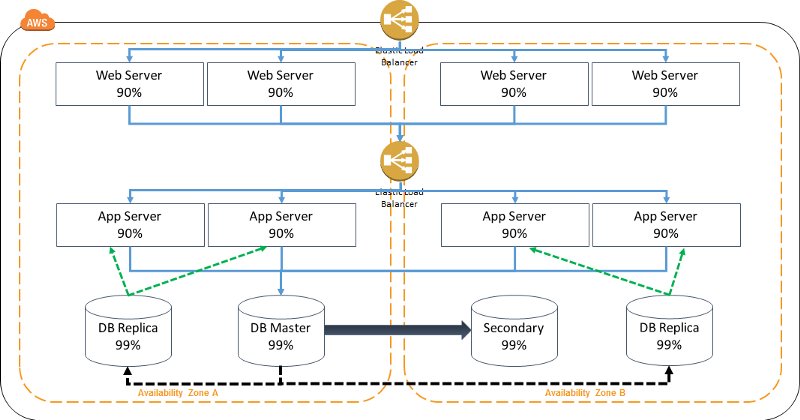
1️⃣ High Availability Architecture
Use:
Multiple Availability Zones
Load Balancers
Auto Scaling Groups
Flow:
User → Load Balancer → Multiple EC2/ECS tasks → Healthy instance only
If one AZ fails → traffic goes to others.
2️⃣ Fault Tolerance
Assume failures will happen.
AWS tools:
Health checks
Auto replacement
Self-healing instances
Result:
System heals itself.
3️⃣ Monitoring & Observability
Using:
CloudWatch metrics
Logs
Alarms
Dashboards
SRE mindset:
If it’s not monitored, it’s broken.
4️⃣ Error Budgets
Example:
SLO = 99.9%
Allowed downtime = 43 minutes/month
If error budget is exceeded:
Stop new features
Focus on reliability
This balances speed vs stability.
5️⃣ Automation Over Manual Work
SRE rule:
If you do something twice, automate it.
Using:
Terraform
CI/CD
Auto scaling
Scripts
Less human work → fewer mistakes.
6️⃣ Capacity Planning
Questions:
How many users today?
How many next month?
AWS helps with:
Auto scaling
Metrics-based scaling
Forecasting
No guesswork.
7️⃣ Incident Management
When outage happens:
Detect
Mitigate
Communicate
Postmortem
Postmortem:
What happened
Why
How to prevent
No blaming.
Real AWS SRE Example
E-commerce site:
ALB
ECS across 2 AZs
Auto scaling
CloudWatch alarms
Rolling deployments
Result:
Zero downtime deployments
Automatic recovery
High availability
That’s SRE in action.
How DevOps Engineers Move Toward SRE
Learn monitoring deeply
Understand system design
Think in reliability terms
Automate everything
You don’t need a new job title.
You need a new mindset.
Interview Angle 🎯
SRE-style answers impress interviewers:
“I monitor error rate and latency, not just CPU.”
That shows maturity.
🔚 Conclusion
AWS gives the tools.
SRE gives the philosophy.
Together:
Systems run longer
Fail less
Recover faster
DevOps builds the road.
SRE keeps the road safe.
Master SRE concepts on AWS, and you become a reliability-focused cloud engineer.
Happy Learning……


